When floodwaters rise, every minute counts.
Severe floods recently struck Henan Province and Guangzhou City in China. In Henan, record rainfall turned streets into fast — moving rivers. In Guangzhou, Typhoon — related storms caused the Pearl River to overflow its banks.
Hundreds of thousands of people faced evacuation. Roads were blocked. Drainage systems failed.
Emergency teams needed equipment that could work in water, mud, and soft marshland.
Conventional excavators sink in wet ground. They cannot reach flooded areas. Their tracks lose traction in silt. Their engines flood in deep water.
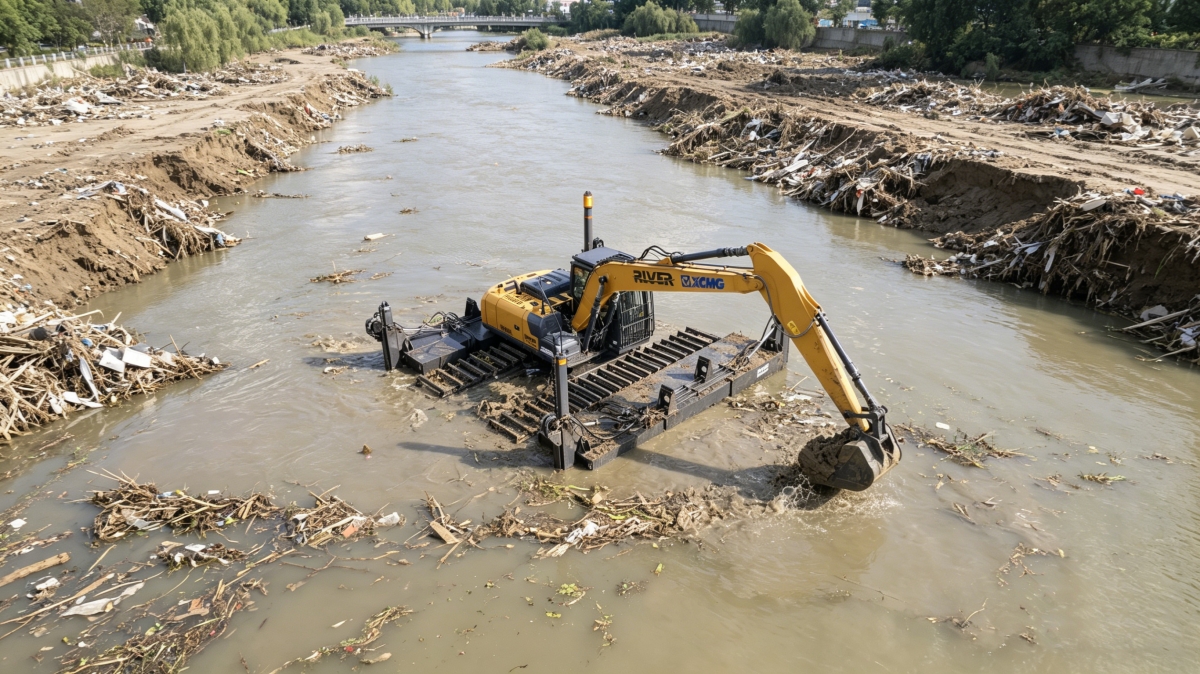
The solution came as amphibious excavators — machines that float on pontoons and walk on spuds. These unique vehicles combine the mobility of a boat with the digging power of an excavator.
This article shows how RIVER amphibious excavators supported flood control in Henan and Guangzhou. The effort brought cutting — edge technology to emergency response.
How These Machines Help in Flood Control
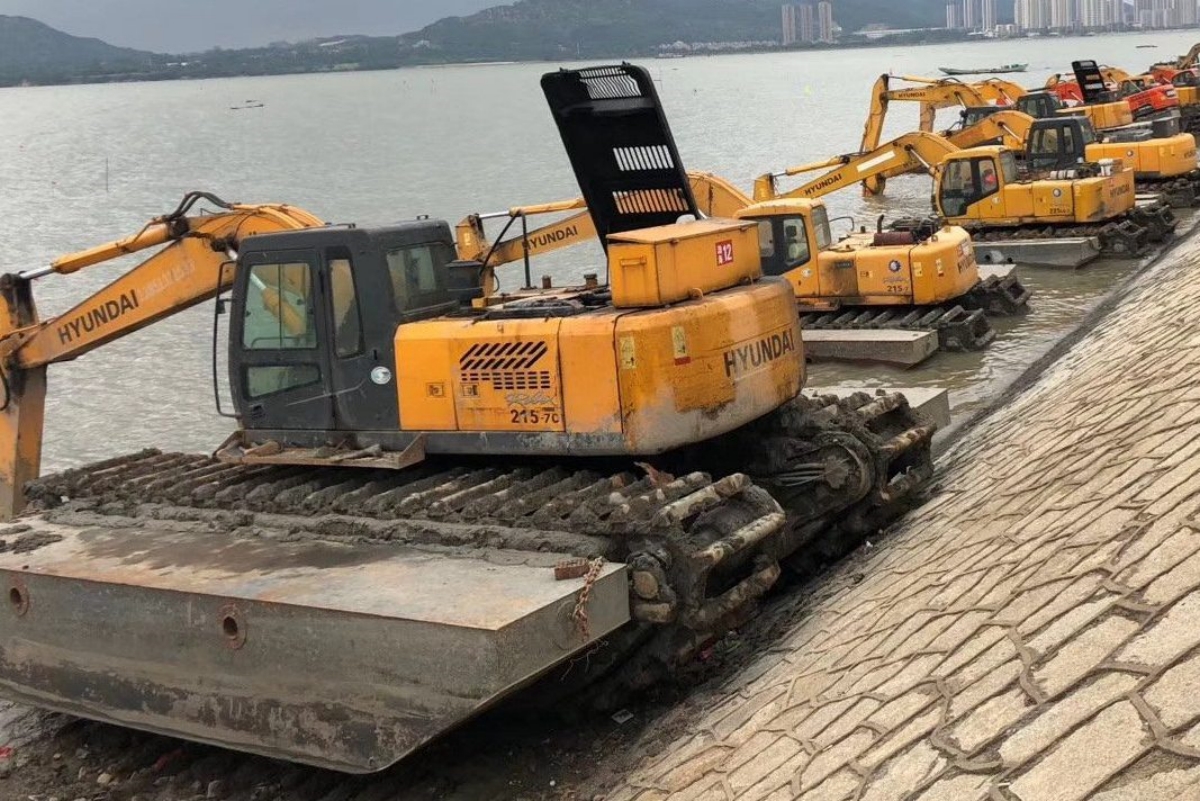
The flood operations required three main tasks: clearing river silt, reinforcing banks, and removing debris.
Each task demanded a different setup. RIVER provided interchangeable attachments for every situation.
Task 1 – River Dredging
Heavy rains blocked rivers with silt and sand, reducing drainage. A standard excavator cannot work in water.
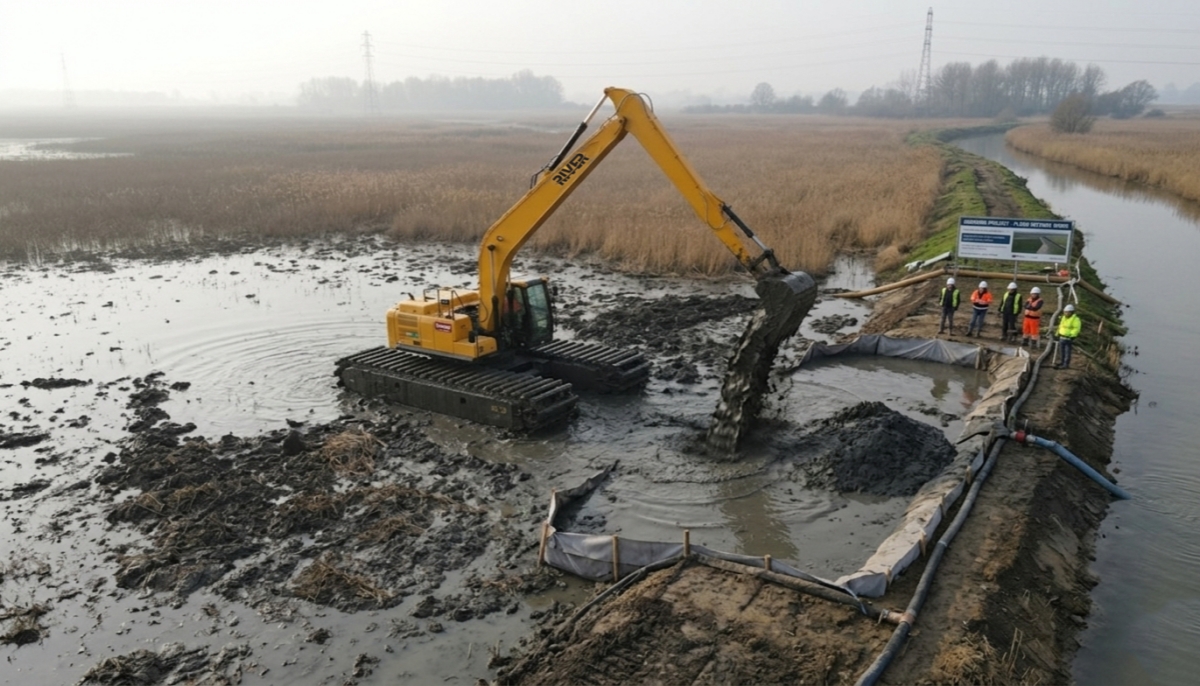
But an amphibious excavator floats on pontoons. It drives steel spuds into the riverbed for stability. The operator then attaches a hydraulic dredging pump to the arm.
The pump’s cutter head loosens compacted sediment. The suction hose then transfers the slurry to a disposal area on shore. This restores water flow quickly.
The machine’s hydraulic system delivers consistent power even when partially submerged. In Zhengzhou, Henan, RIVER machines cleared over 5,000 m³ of sediment in just 48 hours.
Task 2 – Levee Reinforcement
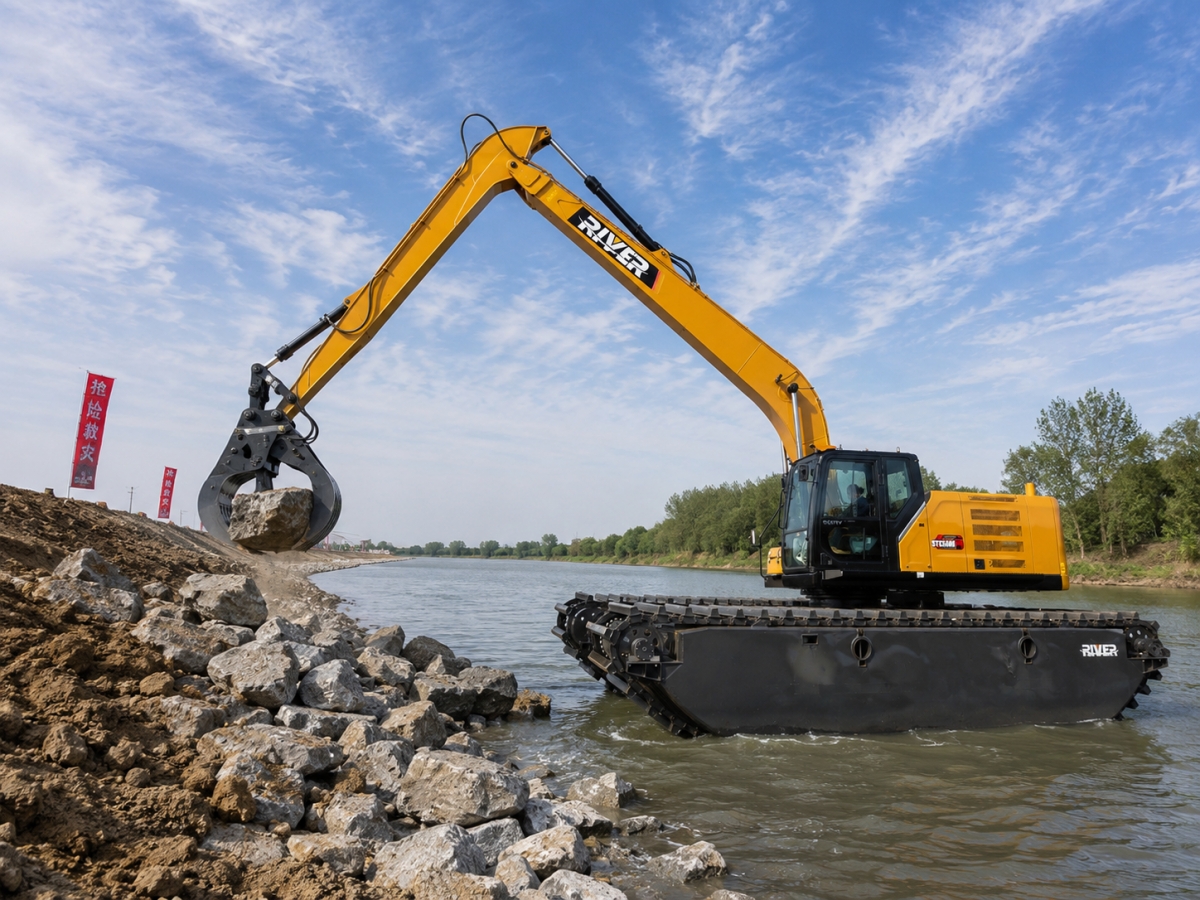
Floodwaters weaken riverbanks. In Guangzhou, teams needed to place sandbags and rocks along vulnerable sections of the Pearl River.
The amphibious excavator traveled through shallow water and soft mud to reach the levee. Its long arm lifted heavy materials precisely where needed.
Operators used a grapple attachment to place individual rocks. This stopped erosion and prevented breaches. The work was completed two days ahead of schedule.
Task 3 – Flooded Area Debris Removal
After the floods, roads and fields stayed underwater. Fallen trees, cars, and household garbage blocked drainage channels.
Traditional machines could not enter because the water was too deep for wheeled loaders but too shallow for barges.
These amphibious excavators — also configurable as a river dredger — navigated through floodwater with ease. They cleared debris, reopened channels, and allowed rescue boats to pass.
RIVER supplied six units for both missions. Each unit featured reinforced pontoons, hydraulic spuds, and a high — reach boom.
Results impressed local authorities: silt removal increased by 300%, and levee repairs finished days early. No equipment got stuck or flooded.
Technical Advantages of RIVER Amphibious Excavators
Why did RIVER machines perform so well?
First, our pontoons are fully sealed and made of high — strength steel. They resist punctures from submerged debris.
Second, the hydraulic spuds can be operated from the cab. The operator lowers them in seconds, anchoring the machine firmly.
Third, all engine and hydraulic components are mounted above the waterline. This prevents water damage even in 1.5 — meter depths.
Finally, RIVER offers a river dredger conversion kit. This turns a standard amphibious excavator into a high — capacity slurry pump in under two hours.
These features make RIVER the trusted choice for flood control agencies worldwide.
Other Applications of Amphibious Excavators
These machines are not only for flood control. They add value to many water — related jobs. RIVER also offers river dredger variants for specialized tasks.
Application 1 – Swamp and Marshland Development
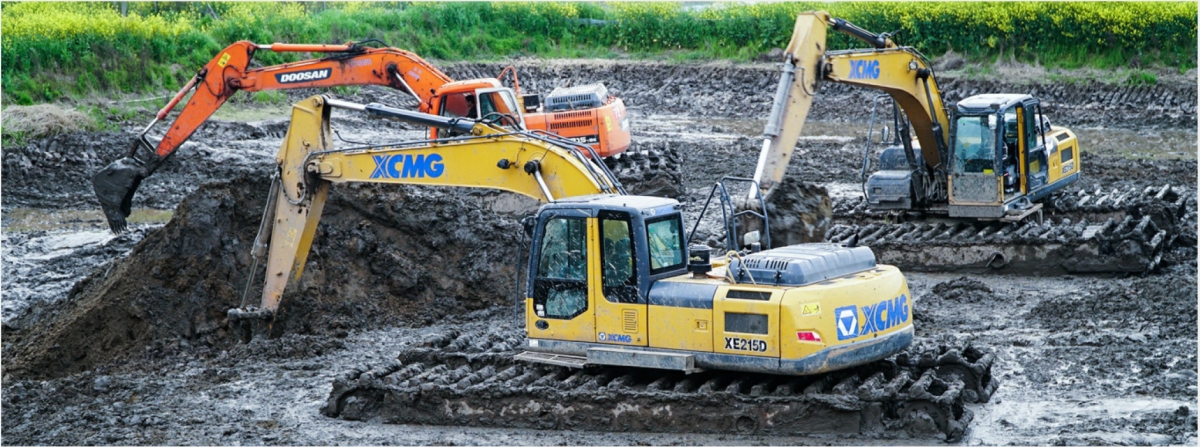
Building roads or drainage in a swamp or marsh is hard with standard gear. An amphibious excavator floats on soft ground without sinking. It digs ditches, clears vegetation, and prepares sites for construction.
Application 2 – Pond and Lake Cleaning
Fish farms and recreational lakes accumulate silt over time. A river dredger version pumps sludge to shore. The same machine removes aquatic weeds and deepens the basin. This improves water quality and fish health.
Application 3 – Coastal Wetland Restoration
Restoring mangroves or salt marshes requires working in tidal zones. Conventional machines get stuck. The amphibious excavator moves with the tide, using spuds to anchor during work — ideal for eco — projects.
Application 4 – Mining Tailings Management
Mining operations produce tailings ponds filled with wet sand and silt. Standard equipment cannot safely enter these unstable areas. An amphibious excavator or river dredger can pump tailings to treatment facilities, reducing environmental risk.
RIVER customizes every machine. We offer different pontoon sizes, spud lengths, and attachments — dredge pumps, long reach arms, grapple buckets, and cutter heads.
Whether you need a river dredger for heavy slurry or a multi — purpose amphibious excavator for general construction, RIVER delivers.
Summary
Flood control demands equipment that works where water meets land. Standard excavators fail in swamps, marshes, and flooded zones.
RIVER amphibious excavators solve this problem.
In the Henan and Guangzhou floods, RIVER machines cleared river silt, reinforced levees, and removed debris — floating on pontoons and anchoring with spuds. The river dredger configuration handled heavy dredging.
From flood emergencies to swamp development, lake cleaning, and mining tailings, RIVER helps you work safely in wet environments.
Contact RIVER’s team today to discuss your specific needs.
Frequently Asked Questions
Q: How deep can an amphibious excavator work?
A: RIVER’s machines operate in water up to 5 meters, depending on pontoon size and spud length. For deeper applications, we offer extended spuds.
Q: What is the difference between an amphibious excavator and a river dredger?
A: A river dredger is a specialized configuration for pumping sand and silt. The standard amphibious excavator handles digging, lifting, and clearing. One machine can serve both roles with attachment changes.
Q: Can I use one in saltwater?
A: Yes. RIVER offers anti — corrosion coatings, stainless steel hardware, and marine — grade paint for coastal and saltwater applications.
Q: How fast does RIVER deliver?
A: Standard models ship within 30 days. Custom builds take 45 — 60 days, depending on specifications. We provide tracking updates throughout.
Q: Do you provide operator training?
A: Yes. RIVER includes a detailed training manual and video. On — site training by our engineers is also available upon request for larger fleets.
Q: What attachments are available?
A: We offer dredge pumps, long reach arms, grapple buckets, cutter heads, clamshell buckets, and rippers. Almost any excavator attachment can be adapted.
Contact RIVER today for a custom amphibious excavator or river dredger solution. We ship worldwide.